
Docs
Sealed Protocol: Technical Overview
Status: public preview. Payments on the site are simulated until the mainnet launch; the vault contract and the agent run on NEAR testnet today. This document describes the system as built. Where it says what users are trusting, it matches the
/trustpage (docs/TRUST_MODEL.md).
Abstract
Sealed is a chain-abstracted, privacy-preserving payments protocol that turns every X (Twitter) account into a multichain receiving endpoint without any onboarding. Deposit addresses on Bitcoin, every major EVM chain and Solana are derived deterministically from the account's immutable numeric X user ID through NEAR Chain Signatures, a threshold multi-party computation (MPC) signing network. Value is settled through NEAR Intents, an intent-centric, solver-driven cross-chain settlement layer, into a confidential balance on NEAR's private execution layer (Confidential Intents). Ownership is established by an OAuth 2.0 identity attestation verified inside a Trusted Execution Environment (Intel TDX via dstack) by a remotely attested Shade Agent, and every signature is mediated by an on-chain policy engine, the vault smart contract, which enforces rate limits, time-delayed execution and a public governance timelock, and exposes a one-way migration path to full self-custody.
1. Design invariants
The protocol is specified by ten invariants (the product rules R1–R10), each enforced in code and
covered by tests (docs/VERIFICATION.md, "Rules R1–R10").
| Invariant | Technical form |
|---|---|
| R1 Identity-bound addressing | Keys are a pure function of the immutable numeric X user ID, never the mutable handle string, so handle renames are address-stable and recycled handles are address-isolated. |
| R2 Zero-onboarding receivability | Addresses are computed offline from public parameters; every account is receivable before it ever interacts with the protocol. |
| R3 Settlement finality | No decline, return-to-sender, expiry or clawback exists at any layer (UI, API, agent RPC, contract ABI). Pre-credit refunds are handled natively by NEAR Intents. |
| R4 Confidentiality by default | In-app sends are confidential intents; public deposits are swept into the confidential balance; balances and activity are visible only to the authenticated owner. |
| R5 Read-only identity oracle | X is used only for handle-to-ID resolution, public profile metadata and authentication; OAuth scopes are users.read tweet.read and the token is revoked after one call. |
| R6 Operator exclusion | The policy contract has no code path that lets the operator move user funds; upgrades pass a public 14-day timelock and the contract can be frozen permanently (lock_forever). |
| R7 Sovereign exit | Owners can register their own key on their NEAR Intents account and revoke the system key, moving to full self-custody. |
| R8 Disclosed trust assumptions | The MPC network, the TEE, the private layer's validator set and X itself are documented trust assumptions (§12). |
| R9, R10 Brand discipline | No third-party product names in copy; every brand string is sourced from a single configuration module. |
2. Layered architecture
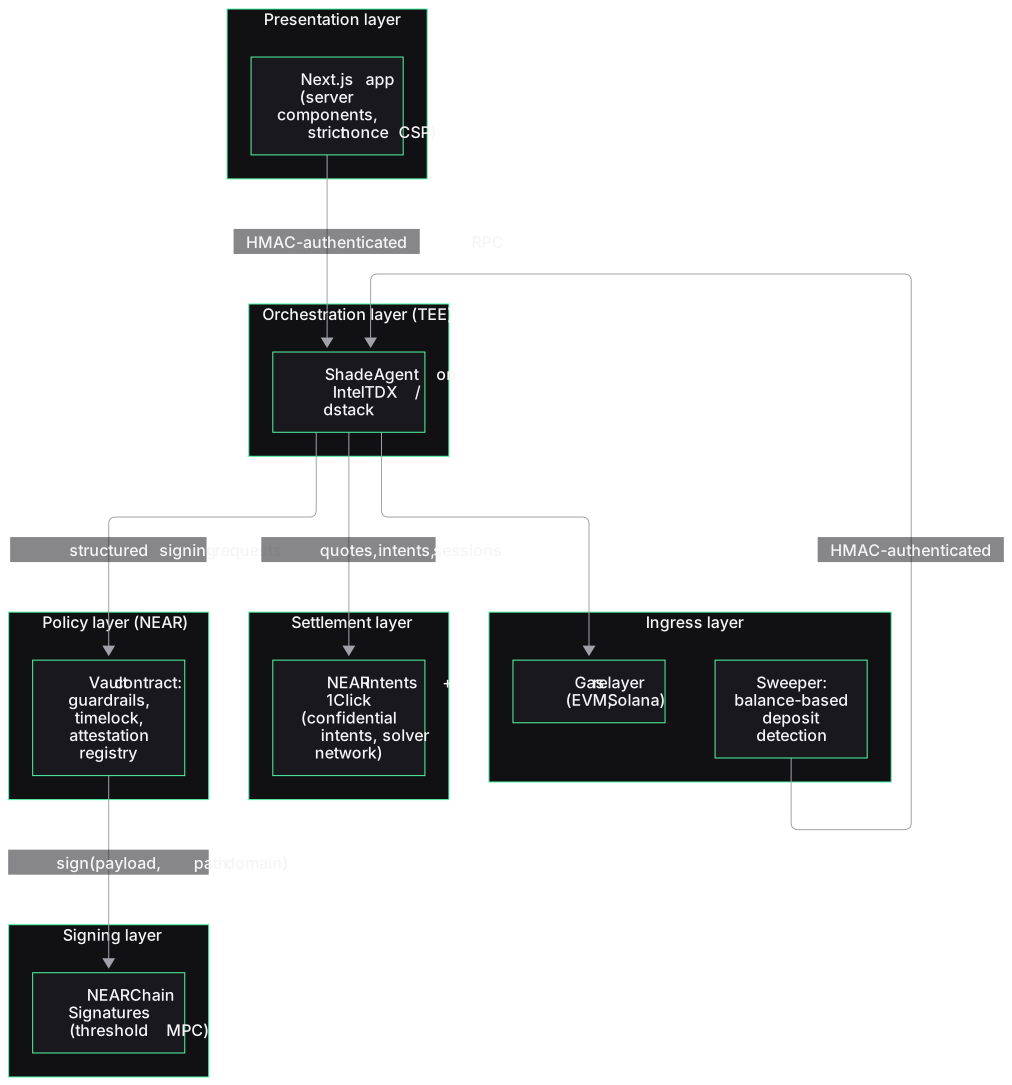
| Layer | Component | Responsibility |
|---|---|---|
| Presentation | apps/web |
Handle resolution, quoting UX, owner console; stateless with respect to keys and private balances. |
| Orchestration | apps/agent |
Authentication, session issuance, intent construction and submission, sweep planning, relayer control. |
| Ingress | services/sweeper, relayer in apps/agent |
Watches public deposit addresses, drives sweeps, funds gas, audits registered bridge addresses. |
| Policy | contracts/vault |
The only MPC predecessor for handle paths; validates every payload it signs. |
| Signing | NEAR Chain Signatures (v1.signer) |
Threshold ECDSA (secp256k1) and EdDSA (Ed25519) signatures with additive key derivation. |
| Settlement | NEAR Intents (intents.near) and 1Click |
Cross-chain swaps, confidential balances, withdrawals to external chains. |
3. Identity layer
- Identity oracle. Handle resolution uses X API v2 with an app-only bearer token, fronted by a cache-first resolver (handle to ID for 24 hours, profile for 6 hours, negative results for 10 minutes) and per-IP fixed-window rate limiting, because every uncached lookup consumes metered API credits against a 300-requests-per-15-minutes application budget.
- Authentication. Sign in with X is OAuth 2.0 Authorization Code with PKCE, executed entirely
inside the TEE agent. The PKCE verifier and return path travel inside the
stateparameter, sealed with AES-256-GCM under a TEE-derived key, so no server-side OAuth state store exists. The agent exchanges the code, calls/2/users/meexactly once, revokes the access token, and mints a first-party session. - Sessions.
v1.<payload>.<mac>tokens, HMAC-SHA256 over a key derived inside the enclave, 15-minute lifetime; value-moving and key-management operations additionally require an authentication event less than 5 minutes old (step-up freshness). - Adversarial handle hygiene. Homoglyph (lookalike Unicode) detection, rename and recycled-handle warnings from a handle-to-ID history, new-account and protected-account signals.
4. Deterministic multichain address derivation
Addresses are derived with NEAR Chain Signatures' additive key-derivation scheme. The derivation path binds the protocol version, the identity and the key family:
path      = "x/{xUserId}/v1/{family}"            family ∈ { evm, btc, sol, intents }
epsilon   = SHA3-256("near-mpc-recovery v0.1.0 epsilon derivation:" ‖ predecessor ‖ "," ‖ path)
secp256k1 = root_secp + int_be(epsilon) · G              (domain 0: evm, btc)
ed25519 = root_ed + (int_le(epsilon) mod L) · B (domain 1: sol, intents)- The predecessor is the vault contract, so only the vault can request signatures for these keys. The MPC network never reconstructs a private key: signatures are produced jointly by the threshold of independent nodes.
- Address encodings: EIP-55 checksummed Keccak-256 addresses (one EVM key shared across
Ethereum, Base, Arbitrum, Robinhood Chain and BNB Chain), native SegWit P2WPKH (
bc1q…) for Bitcoin, base58 Ed25519 for Solana, and a 64-hex implicit NEAR account for the handle's NEAR Intents account. - Frozen at launch. The scheme is covered by shared TypeScript/Rust test vectors, 80 golden keys recorded from both live signer contracts, property-based signature-recovery tests and a live testnet signing test.
5. The policy engine: vault contract
The vault is a NEAR smart contract (Rust, near-sdk) acting as a capability-scoped signing proxy.
It never signs an opaque hash: it builds every payload itself or parses externally generated ones
against a strict grammar.
Signing surface.
| Method | Payload | Policy |
|---|---|---|
request_intents_action |
NEP-413 intents: transfer, add_public_key, remove_public_key for the handle's account |
Per-handle nonce, 10-minute request expiry, intent deadline ≤ 30 minutes, per-token rolling-window cap |
request_external_intent |
1Click-generated NEP-413 transfer message, parsed and validated on-chain | Signer must be the handle's account; token allow-list; cap; delay threshold |
execute_queued / execute_queued_external |
Actions that waited in the public delay queue | Executable only after the delay; cancellable by the owner or the agent meanwhile |
request_sweep |
EIP-1559 (EVM), BIP-143 P2WPKH (Bitcoin), Solana system and SPL transactions built on-chain | Destination fixed by a governance-approved route; network fee bounded by the route and by 20% of value |
Guardrails. A per-handle, per-token rolling 24-hour spend window (window_add, checked
arithmetic, property-tested with proptest), a delay threshold above which transfers enter a public
24-hour queue, and owner-key additions that always queue. If the MPC call fails, the callback
restores the consumed allowance (compensating transaction). Tokens without a configured limit fail
closed.
Governance. A multisig can only propose changes (limits, approved agent measurements and CPU
identifiers, sweep routes, code upgrades), which execute after a public 14-day timelock. The only
immediate governance powers reduce capability: a 72-hour self-expiring circuit breaker,
per-instance agent revocation, proposal cancellation and lock_forever, which removes the upgrade
path permanently. After deployment the vault account holds no access keys: its code can change only
through its own timelocked execute_upgrade.
Agent registry. In TEE mode, agents register with a dstack remote-attestation quote verified
on-chain by the vendored shade-attestation crate (Intel TDX DCAP verification): approved
measurements (the published code hash), an approved platform identifier (PPID), and report data
binding the quote to the agent's NEAR account. Registrations expire after 7 days; an agent whose
measurements are revoked is evicted on its next call.
6. Confidential settlement: NEAR Intents and 1Click
- Intent-based settlement. Every spend from a handle's balance is a 1Click quote: solvers
compete to fill it, and settlement happens atomically in the
intents.nearverifier contract. - Confidential sends. In-app sends request quotes with
recipientType: CONFIDENTIAL_INTENTSand a confidentiality level, delivering into the recipient's account on NEAR's private layer (the NEAR Private Shard). Confidential balances are held as IMT-wrapped tokens (imt:{minter}:{token}). - Account authentication. Reading a confidential balance needs a User-Session: the vault signs
an empty-intents NEP-413 login message with a versioned nonce (the verifier's current salt
plus a timestamped random component);
/v0/auth/authenticatereturns a short-lived token held only in enclave memory. - Externally generated intents. Spending confidential balances uses
generate-intent→ vault-side validation and MPC signature →submit-intent. The vault parses the message and enforces signer, token, amount and deadline before signing. - Public balances (credited by sweeps) are read with
mt_batch_balance_of; balances are the union of public and confidential holdings, spent one token at a time.
7. Ingress: public deposits and the sweep pipeline

- Detection is balance-based rather than event-based: Multicall3 batch reads (up to 200
balances per call) at the confirmation depth on EVM chains, Esplora UTXO queries on Bitcoin, and
batched
getMultipleAccounts/ token-account reads on Solana. Observations are untrusted hints: the agent re-reads chain state before planning. - Routes are governance-approved per
{chain}:{asset}. Registered routes deliver to the handle's PoA bridge deposit address after a public 24-hour activation delay and within a per-handle daily cap;omni_evmroutes embed the destination in Omni BridgeinitTransfercalldata, making the destination provable on-chain. - Chain-specific builders: EIP-1559 transactions with OP Stack L1 data-fee bounds on Base;
BIP-143 SegWit sighashes for Bitcoin; Solana transactions with on-chain derivation of associated
token accounts (program-derived addresses with an Ed25519 off-curve check),
CreateIdempotentandTransferChecked. All builders are byte-for-byte identical to reference implementations in the test suite. - Gas abstraction. A relayer hot wallet (EVM and Solana keys derived from the enclave master key) funds token sweeps. It accepts an X ID, never an address, derives the destination itself, and has per-funding and daily budgets; it is not reachable over the RPC surface.
- Continuous verification. The sweeper audits every registered sweep address against the bridge hourly and raises an error-level alert on divergence, well inside the 24-hour activation window.
8. Egress: withdrawals, swaps and shielded exits
- Withdrawals to any supported chain and swaps inside the confidential balance are 1Click quotes executed through the vault's external-intent path, with step-up authentication.
- Delay-queue semantics: above the per-token threshold, a withdrawal enters the public queue; when due, the agent re-quotes and spends the queued allowance with a fresh message.
- Shielded exit: ZEC withdrawals target unified Zcash addresses for continued privacy after leaving the protocol (delivery to the shielded receiver is confirmed in the mainnet smoke test).
- Fee mechanics: 0.75% on withdrawals, collected as a separate vault-signed transfer to the treasury within the same guardrail window, rounded up to the base unit; the holder discount and buyback module are implemented and switched off until a token exists.
9. Sovereign exit: from system key to self-custody
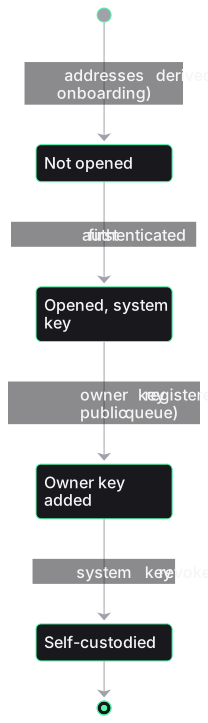
- Proof of possession: new owner keys sign a one-time challenge: Ed25519 (Solana wallets, NEAR
keys), EIP-191
personal_signwith public-key recovery (EVM wallets), or a WebAuthn P-256 assertion bound to the site origin (passkeys). - Queued registration: additions always wait in the public delay queue, then are submitted to
intents.nearasadd_public_keyintents by the agent's executor account (an implicit NEAR account derived from the enclave master key, used only for gas). - System-key revocation requires an active wallet key (passkeys are origin-bound) and
emits a
remove_public_keyintent; from then on the vault refuses to act for the handle.
10. Trusted execution and key management
- Remote attestation. The agent runs as a Shade Agent in a confidential VM (Intel TDX, dstack on Phala Cloud). Its image is a single esbuild bundle in a digest-pinned, reproducible OCI image: a clean rebuild of the same commit yields the same digest. The approved code hash is the SHA-256 of the canonical measurement set (MRTD, RTMR0–2, the key-provider event digest and the app-compose hash) that governance approves through the timelock.
- Key hierarchy. Inside the enclave, a 32-byte master key comes from dstack's key management service, bound to the attested application identity. Every operational key is derived from it with HKDF-SHA256 under a distinct context label:
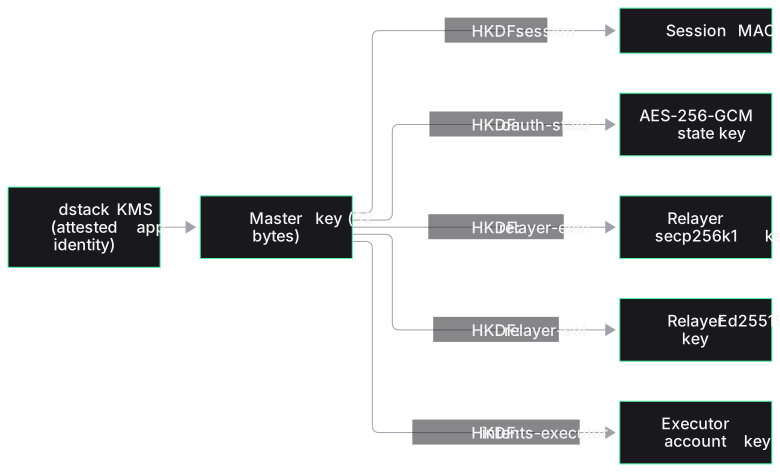
- Horizontal scalability. Because every key is derived from the attested identity, any approved instance can serve any session: agents are stateless replicas behind the vault's registry.
11. Transport, application security and data minimization
- Service mesh authentication: web-to-agent and sweeper-to-agent calls use an allow-listed RPC table with HMAC-SHA256 request signing over method, path, timestamp, nonce and body digest, a 60-second validity window and a replay cache.
- Web hardening: strict nonce-based Content Security Policy, CSRF defences with login-CSRF binding of the OAuth state, per-IP rate limiting, schema-validated API contracts (zod) on both sides of every call, and a zod-free client entry that keeps first-visit bundles small.
- Data minimization: Postgres holds only caches and public metadata; no private balances, OAuth tokens or sender-recipient relationships are persisted. Structured logs are redacted by key and by value pattern, with dedicated tests.
- Supply-chain controls: pinned toolchains, reproducible contract and agent builds, secret scanning on every commit, and a dependency audit gate in CI.
12. Privacy model and trust assumptions
Confidential: who a private payment was for, every balance, incoming private payments, and activity history.
Public by construction: deposits into the private layer and withdrawals out of it (on the chain where they happen); payments to a handle's public addresses and their sweep; while a handle still uses the system key, the token and amount of each outgoing move, because guardrails are enforced on-chain. Timing and amount correlation can link transactions. Confidential is not anonymous.
Trust assumptions:
- The X account. Whoever controls it can sign in and, until an owner key is added, spend within the guardrails.
- The MPC network. A colluding threshold of Chain Signatures nodes could sign arbitrary payloads.
- The TEE. A hardware or hosting compromise could impersonate the agent; guardrails, the delay queue and the circuit breaker bound the damage for system-key handles.
- The private layer. Confidential state depends on NEAR's approved validator set.
- Code correctness. The contract and agent have not been audited yet.
13. Engineering and verification
- Monorepo: pnpm workspaces and Turborepo; strict TypeScript; Rust for the contract, built in a pinned cargo-near container.
- Testing pyramid: 579 unit tests; property-based testing with fast-check (derivation, fee math) and proptest (the guardrail window); contract unit tests (92% line coverage) and near-sandbox integration tests against a signing MPC stand-in; byte-identical transaction vectors against reference libraries; 62 Playwright end-to-end tests (all eight user journeys, WCAG 2.1 AA accessibility scans, JavaScript page-weight budgets).
- Live verification: the journeys run through the deployed testnet vault and the real testnet MPC network; vault-signed sweeps are accepted by Base Sepolia and Solana devnet nodes.
- Quality gates: lint, type-check, secret scan and formatting on every commit; 80% line coverage enforced per package.
Glossary
| Term | Meaning here |
|---|---|
| Chain Signatures | NEAR's MPC service that signs for keys on other chains, derived per (predecessor, path). |
| Predecessor | The NEAR account that calls the MPC signer; here always the vault. |
| NEAR Intents | NEAR's intent settlement layer (intents.near), filled by solvers. |
| Confidential Intents | The private execution layer of NEAR Intents, holding confidential balances. |
| 1Click | The quoting and execution API in front of NEAR Intents. |
| NEP-413 | NEAR's standard for signed off-chain messages, used for intents and logins. |
| System key | The vault-controlled key on a handle's NEAR Intents account, replaceable by the owner's key. |
| Shade Agent | An agent framework whose instances prove their code to a NEAR contract through remote attestation. |
| Measurements / code hash | TDX register values describing the booted software; their hash is the published code identity. |
| Guardrails | Per-token daily caps and delay thresholds enforced by the vault. |
| Circuit breaker | A 72-hour, self-expiring pause of all fund-moving signatures, callable by governance at once. |
| Sweep | Moving a public deposit from a handle's address into its NEAR Intents account. |
Further reading: docs/ARCHITECTURE.md (every flow with diagrams), docs/THREAT_MODEL.md,
docs/TRUST_MODEL.md, docs/DEPLOYMENT.md, DECISIONS.md.